

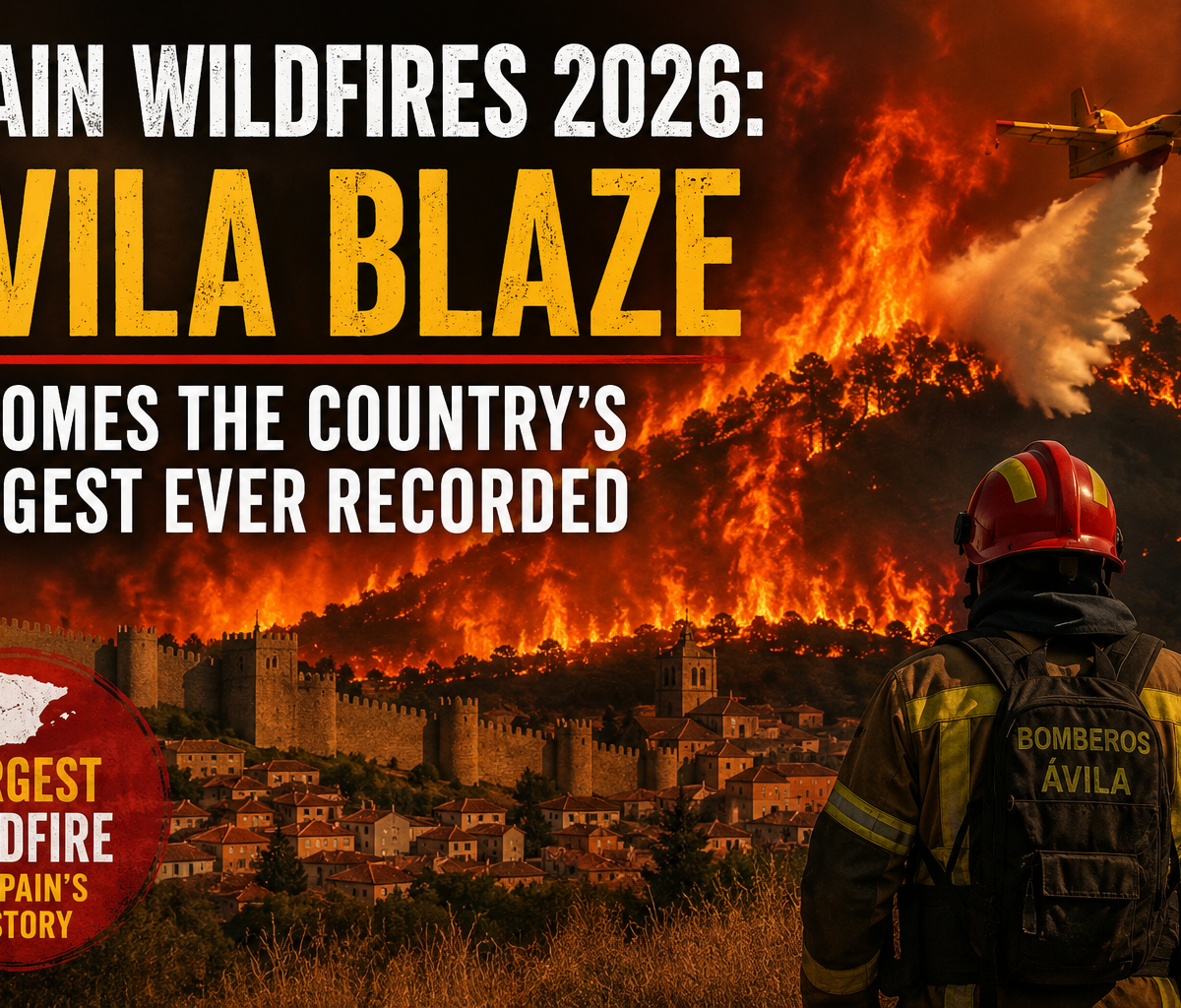
The Spain Wildfires 2026, tearing through Ávila province west of Madrid has grown into the largest fire ever recorded in Spain, according to the Spanish government, forcing tens of thousands of people from their homes and pushing firefighters to fundamentally rethink their tactics.
How Big Is the Ávila Fire?
The blaze, which broke out near Burgohondo on July 22 and swept through the Alberche and Tiétar valleys, had burned roughly 50,000 hectares by July 26 — an area five times the size of Barcelona. That surpasses the previous record holder, the August 2025 fire at Larouco, Quiroga and Oencia in northwest Spain, which had burned close to 37,800 hectares.
Spain’s ecological transition minister, Sara Aagesen, confirmed the milestone from a forward command post near Madrid, underscoring just how unusual this fire season has become.
Tens of Thousands Forced to Flee
Nearly 90,000 people have been evacuated or confined across three provinces of central Spain because of the Ávila fire alone, with additional evacuations tied to a separate blaze in the Madrid region and another in eastern Castellón. No deaths have been reported from these fires so far, though officials caution the situation remains dangerous and unpredictable.
Firefighters Change Their Playbook
Veteran firefighters say they’ve never seen anything like it. One 20-year emergency brigade member described the blaze as being “without precedent,” noting that his unit has had to abandon its usual wilderness-focused approach in favor of prioritizing evacuations and property protection first. As he put it, the order of operations has flipped: lives first, then homes, and only after that, the forest itself.
Crews are working 12-hour shifts hosing down burning trees and clearing underbrush before it can become additional fuel, while firefighting helicopters continue water drops over the smoldering hills near El Tiemblo.
International Help on the Ground
Spain formally activated the European Union Civil Protection Mechanism to bring in outside support. The EU has since deployed six firefighting aircraft from Greece, Italy, and Turkey, along with 134 additional firefighters and 41 vehicles from Portugal, as the fire strained domestic resources beyond their limits.
What Sparked Such an Extreme Season
Experts and local officials point to a familiar combination: vacant rural properties, unmanaged scrubland, and prolonged heat and drought that has turned vegetation into what one regional forestry official bluntly called “pure gunpowder.” Fires in Spain this summer have also affected the Sierra Norte Natural Park in Guadalajara and the Sierra de Espadán Natural Park near Castellón, and the crisis has coincided with hundreds of thousands more evacuations from wildfires burning across southwestern Europe, including France.
What Happens Next
As of July 29, authorities began allowing some evacuees to return home in areas where the fire has been brought under control, though large sections of Ávila province remain active fire zones. Expect continued EU firefighting support, ongoing evacuation updates, and a broader political debate in Spain over year-round brush-clearing policy as the country grapples with what officials are calling one of its worst fire seasons on record.