


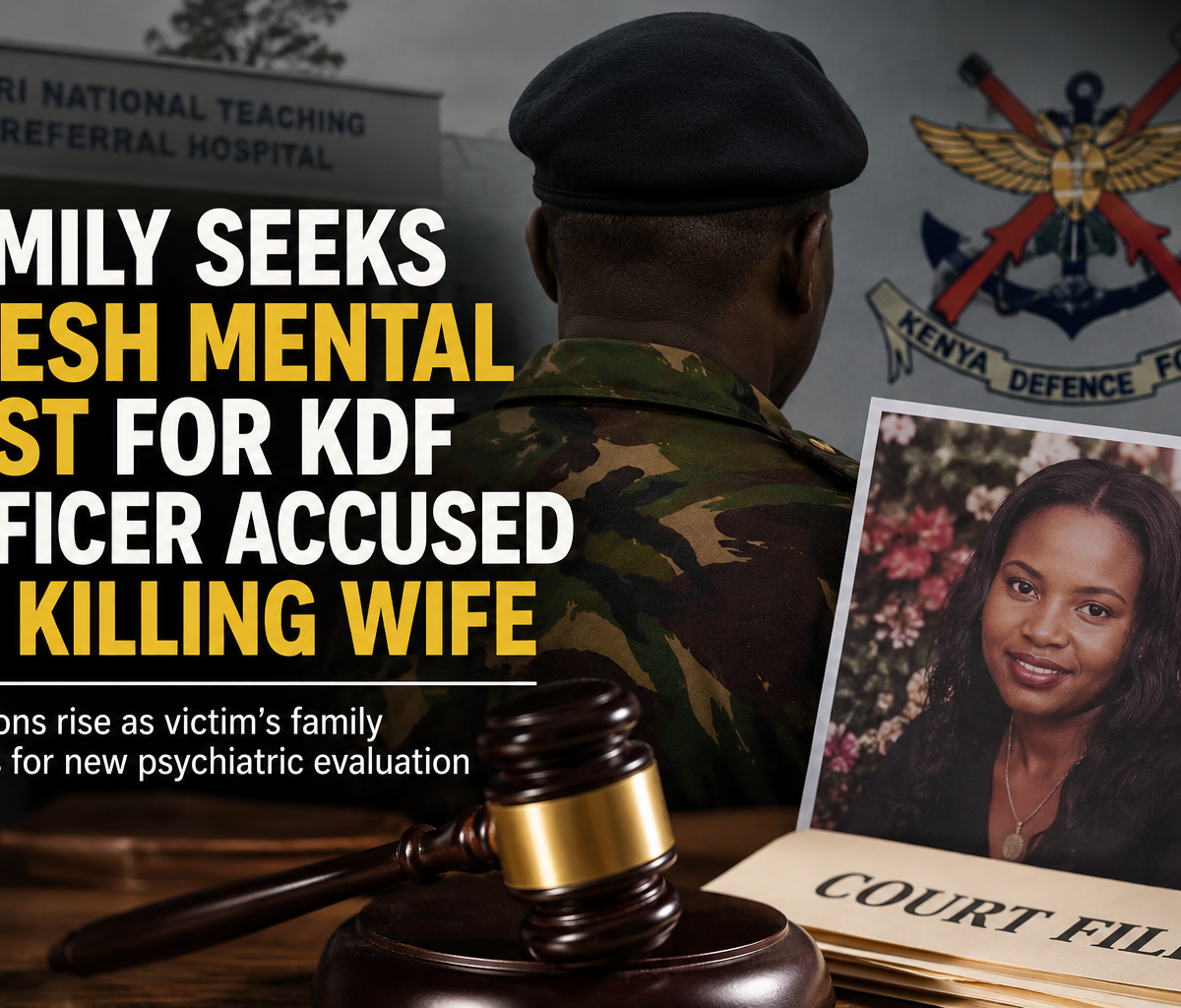
Questions Rise as Victim’s Family Pushes for New Psychiatric Evaluation
The family of a woman allegedly killed by her husband, a Kenya Defence Forces (KDF) officer, is now seeking a fresh psychiatric assessment of the suspect, arguing that justice risks being delayed amid concerns surrounding his mental fitness to stand trial.
The case, which has drawn public attention in Nakuru and beyond, revolves around KDF officer Edwin Muthoni Kaunga, who is accused of murdering his wife, 29-year-old Annita Mugweru, in what prosecutors describe as a tragic case of domestic violence. The latest twist in the matter has emerged after the suspect was declared mentally unfit to take plea and ordered to undergo treatment at Mathari National Teaching and Referral Hospital.
Now, Annita’s grieving family says they want independent verification of the accused’s mental condition, fearing the psychiatric findings could complicate or prolong the murder proceedings.
Court Halts Plea Taking
The case took a dramatic turn when Edwin Kaunga appeared before the Nakuru High Court for plea-taking but failed to answer to the murder charge after medical reports indicated he was mentally unfit to proceed.
According to court proceedings, the psychiatric report submitted before Justice Patricia Gichohi concluded that Kaunga was not in a proper mental state to comprehend the charges facing him or adequately participate in the judicial process. Prosecutors subsequently requested that the suspect be committed to a psychiatric institution for treatment before the criminal proceedings could continue.
The court agreed and ordered his transfer to Mathari Hospital, Kenya’s main referral institution for mental health treatment, pending further medical evaluation and review.
The development immediately triggered mixed reactions from the victim’s family, who insist that justice for Annita must not be derailed.
Why the Family Wants a Fresh Mental Test
Family representatives have reportedly raised concerns over the psychiatric findings, arguing that an independent or fresh mental assessment is necessary to remove any doubt over the accused’s actual condition.
Their concerns stem from fears that the mental health determination could significantly affect the pace and direction of the murder trial. In Kenyan law, a suspect deemed mentally unfit cannot take plea or stand trial until doctors certify that they are capable of understanding court proceedings and instructing legal counsel.
To the family, the issue is not whether mental illness exists, but whether the assessment accurately reflects the accused’s current condition.
Legal experts note that in high-profile murder cases, requests for second psychiatric evaluations are not uncommon—especially when victims’ families fear inconsistencies, delays, or contested medical findings.
If granted, a fresh assessment could either reaffirm the initial report or introduce a different medical opinion that influences how quickly the case proceeds.
The Murder Allegations
According to investigators, Kaunga allegedly killed his wife, Annita Mugweru, during a domestic altercation at their home in the St Mary’s area of Nakuru on April 14, 2026.
Police reports indicate that the victim had previously expressed fears for her safety and had allegedly reported threats before the fatal incident. Authorities later arrested the KDF officer following the alleged stabbing that claimed Annita’s life.
The incident sparked outrage online, with many Kenyans once again raising concerns over rising cases of domestic violence and mental health challenges within disciplined forces.
For Annita’s loved ones, however, the issue remains painfully personal.
Friends and family members have continued to demand accountability, insisting that the legal process must move swiftly despite complications arising from the accused’s medical condition.
What Kenyan Law Says About Mental Fitness
Under Kenyan criminal law, courts cannot proceed with plea-taking if an accused person is found mentally incapable of understanding the charges against them.
In such situations, suspects are usually committed to a psychiatric institution for treatment and regular review until doctors determine they are fit to stand trial.
This legal safeguard exists to ensure fair trial standards are upheld, even in serious criminal cases such as murder.
However, the law also creates difficult emotional situations for victims’ families, who may view prolonged psychiatric treatment as an obstacle to closure.
The balancing act between protecting the rights of the accused and delivering justice to victims often places courts under intense public scrutiny.
A Family Waiting for Justice
As the matter returns to court for mention and medical review, Annita Mugweru’s family says their pursuit of justice remains unchanged.
Their push for a fresh psychiatric examination signals growing unease over how the case is unfolding and reflects a broader national conversation around accountability, mental health, and domestic violence.
For now, the future of the murder case depends heavily on medical findings—and whether the court will agree to reconsider the suspect’s mental fitness through a fresh evaluation.
Until then, one family continues to mourn, waiting for answers in a case that has left many Kenyans asking difficult questions about justice delayed.
Keywords: KDF officer accused of killing wife, Edwin Kaunga case, Annita Mugweru murder, KDF murder case Kenya, Nakuru murder case, Mathari Hospital psychiatric evaluation, domestic violence Kenya.