


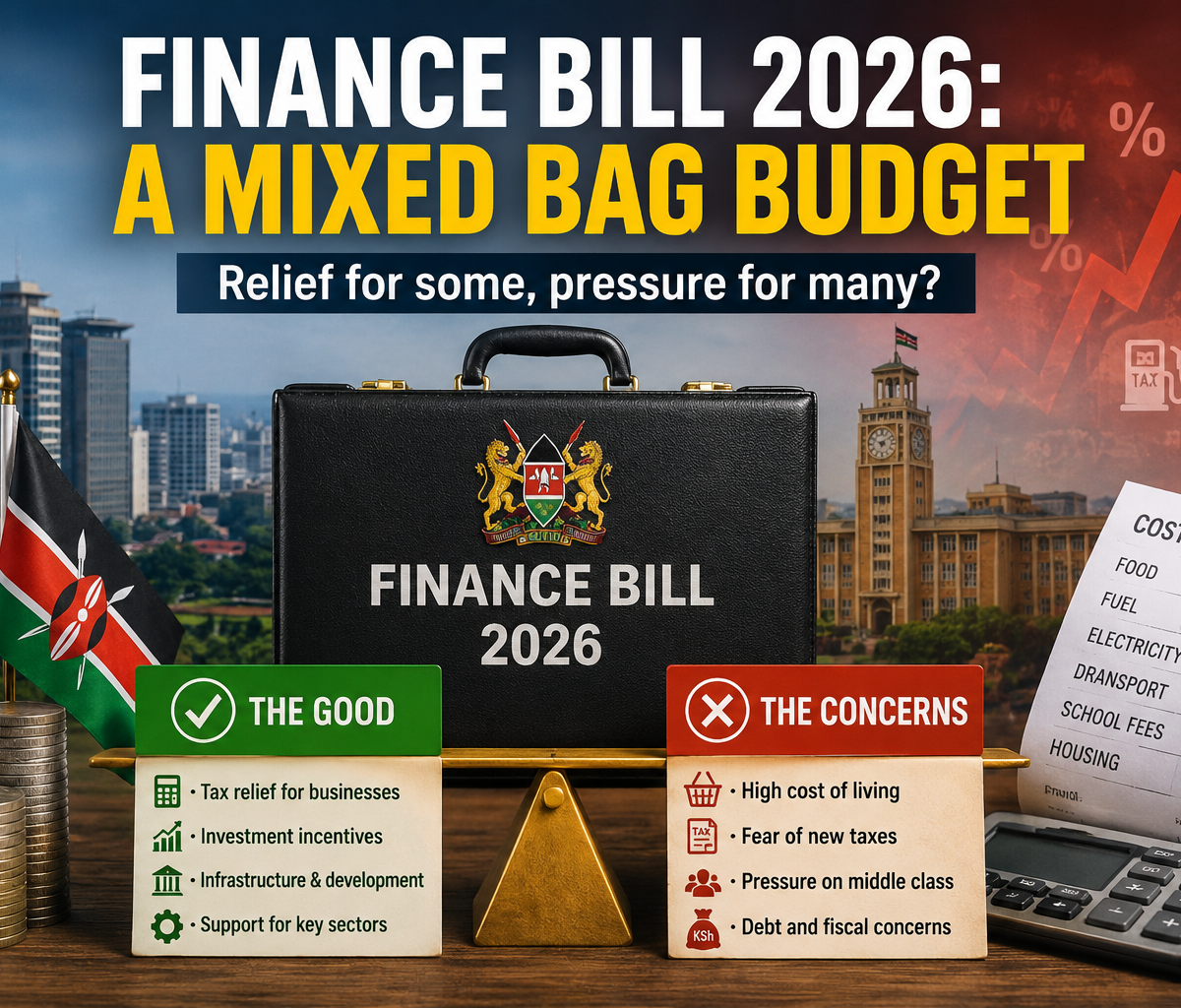
Winners and Losers as Finance Bill 2026 Sparks Debate Over Taxes, Reliefs and Economic Recovery
NAIROBI, Kenya — The Finance Bill 2026 has emerged as one of the most debated economic proposals in recent years, with supporters praising targeted relief measures while critics argue that some provisions may pile more pressure on already struggling households and businesses.
Presented against a backdrop of rising living costs, youth unemployment, public debt concerns, and growing public demand for economic accountability, the bill paints a picture of a government attempting to strike a difficult balance between revenue collection and economic relief.
But does the Finance Bill 2026 genuinely help ordinary Kenyans, or is it simply another balancing act with hidden pain points?
For many observers, the answer is simple: it is a mixed bag budget.
The Good: Relief Measures and Economic Incentives
One of the strongest arguments in favor of the Finance Bill 2026 is its effort to stimulate economic growth while offering selective relief to taxpayers and investors.
Economic analysts say some proposals appear designed to attract investment, encourage manufacturing, and ease pressure on sectors struggling after years of economic slowdown.
1. Tax Relief for Businesses
The government has signaled intentions to create a friendlier investment environment through targeted tax adjustments aimed at boosting enterprise growth.
For businesses — especially small and medium-sized enterprises (SMEs) — any reduction in compliance burden or tax pressure could improve cash flow and encourage expansion.
Supporters argue that a stronger private sector could translate into:
- Increased job opportunities
- More investment inflows
- Higher productivity
- Expanded tax revenue in the long term
Business owners have long complained about multiple taxation and rising operational costs, making relief measures welcome news for some sectors.
2. Infrastructure and Development Spending
The Finance Bill 2026 also aligns with broader government spending priorities in infrastructure, healthcare, education, digital transformation, and agriculture.
Proponents argue that strategic spending can stimulate economic activity and create employment opportunities.
If managed efficiently, investments in roads, healthcare systems, water, energy, and digital services could have long-term economic benefits.
However, many Kenyans remain skeptical due to concerns over corruption, stalled projects, and historical inefficiencies in public spending.
3. Support for Key Sectors
Certain sectors appear poised to benefit from government policy direction under the bill, including:
- Agriculture
- Manufacturing
- Technology and innovation
- Renewable energy
- Affordable housing initiatives
Supporters say targeted incentives could help Kenya become more competitive regionally while supporting local industries.
The Bad: Cost of Living Fears Persist
Despite some positive provisions, critics argue the Finance Bill does little to fully address the financial pressure ordinary Kenyans continue to face.
Many households remain burdened by:
- High food prices
- Expensive electricity bills
- Rising fuel costs
- Costly school fees
- Housing pressures
Consumer rights groups argue that unless disposable income improves significantly, many Kenyans may see little immediate benefit from the proposed changes.
Economists warn that even modest tax adjustments can trigger ripple effects that eventually raise consumer prices.
Middle-Class Anxiety
Kenya’s middle class, often viewed as the country’s tax engine, may continue carrying a disproportionate burden.
Workers have increasingly voiced frustration over deductions, levies, and shrinking take-home pay.
For salaried employees already struggling with inflation, the concern remains whether the Finance Bill provides meaningful relief or merely rearranges existing tax structures.
“People want lower living costs, not just policy promises,” one Nairobi-based economist noted.
The Ugly: Public Trust and Fear of Hidden Taxes
Perhaps the biggest challenge facing the Finance Bill 2026 is public trust.
Following nationwide backlash against previous finance legislation, many Kenyans are now scrutinizing every proposal more closely than before.
Public concern revolves around fears of:
- New hidden taxes
- Increased compliance burdens
- Reduced disposable income
- Rising cost of basic commodities
- Unclear long-term economic impact
Many citizens feel taxation has reached unsustainable levels, especially among young workers and entrepreneurs.
The government, however, insists revenue collection remains necessary to fund development projects and reduce borrowing.
Balancing those competing realities remains politically sensitive.
Debt Pressure Still Looms
Even as the government pushes for increased domestic revenue, Kenya’s public debt conversation refuses to go away.
Critics argue that higher taxation without visible service delivery risks deepening public frustration.
Questions continue to emerge over:
- Debt repayment priorities
- Government expenditure efficiency
- Corruption and wastage
- Fiscal discipline
Many Kenyans say they are willing to contribute through taxes — but only if there is clear accountability and improved public services.
Politics Behind the Budget
The Finance Bill 2026 is not just an economic document — it is also a political test.
With public frustration over taxes having fueled protests and political tensions in previous years, the government faces pressure to avoid triggering another public backlash.
Political analysts believe lawmakers will likely face intense public scrutiny before passing controversial proposals.
MPs may be forced to either defend unpopular measures or push for amendments that resonate better with voters.
The coming parliamentary debates could therefore become highly charged.
A Mixed Bag Budget?
Ultimately, the Finance Bill 2026 appears to offer both hope and uncertainty.
For businesses and selected sectors, there are signs of opportunity and possible relief.
For ordinary households, however, concerns about the rising cost of living remain unresolved.
Whether the bill succeeds may depend on one critical question:
Will Kenyans feel genuine economic relief in their daily lives, or will the burden quietly increase?
As Parliament debates the proposals, citizens, investors, workers, and businesses will be watching closely.
One thing is clear — the Finance Bill 2026 is unlikely to pass without heated national debate.
What’s your take? Is the Finance Bill 2026 fair, or does it burden wananchi even more? Share your views in the comments.